

Some travel spots impress you all at once. Suncheon Bay Wetland does something quieter.
Official Suncheon Bay Wetland WebsiteVISITKOREA – Suncheonman Wetland
VISITKOREA – Yongsan Observatory
You do not really arrive here and feel finished in five minutes. The place opens in layers. First the reeds. Then the boardwalk. Then the low, wide feeling of the wetland itself. And finally, if you keep going, the view from above that makes the whole landscape click into place. VISITKOREA describes Suncheonman Wetland as one of the world’s top five coastal wetlands, stretching along a 3km river with mudflats and reed beds.
What makes it memorable is not drama in the usual tourist sense. It is the way the scenery keeps changing while still feeling calm. The reeds move with the wind. The trail keeps pulling you forward. Birds pass over the marsh. Nothing is loud, but the place never feels empty. That is why this is a strong destination for travelers who like landscapes that unfold instead of destinations that explain themselves right away. This last sentence is an interpretation based on the official site’s emphasis on the reeds, birds, mudflats, and observatory walk.

The most famous payoff comes later. Yongsan Observatory is the spot that gives you the broad view of Suncheon Bay’s S-shaped waterway, and VISITKOREA notes that you reach it by following the trail through the reed fields and crossing Mujingyo Bridge. From up there, the wetland stops feeling like separate details and starts feeling like one complete scene.
That is also where the destination separates itself from other Korea nature posts you may already have. If Nami Island works through tidy tree-lined romance and Seoraksan National Park hits with mountain scale, Suncheon moves differently. It is flatter, softer, and more patient. It does not try to overwhelm you. It makes you stay with the view a little longer. That comparison is my interpretation, based on the different kinds of landscapes involved.
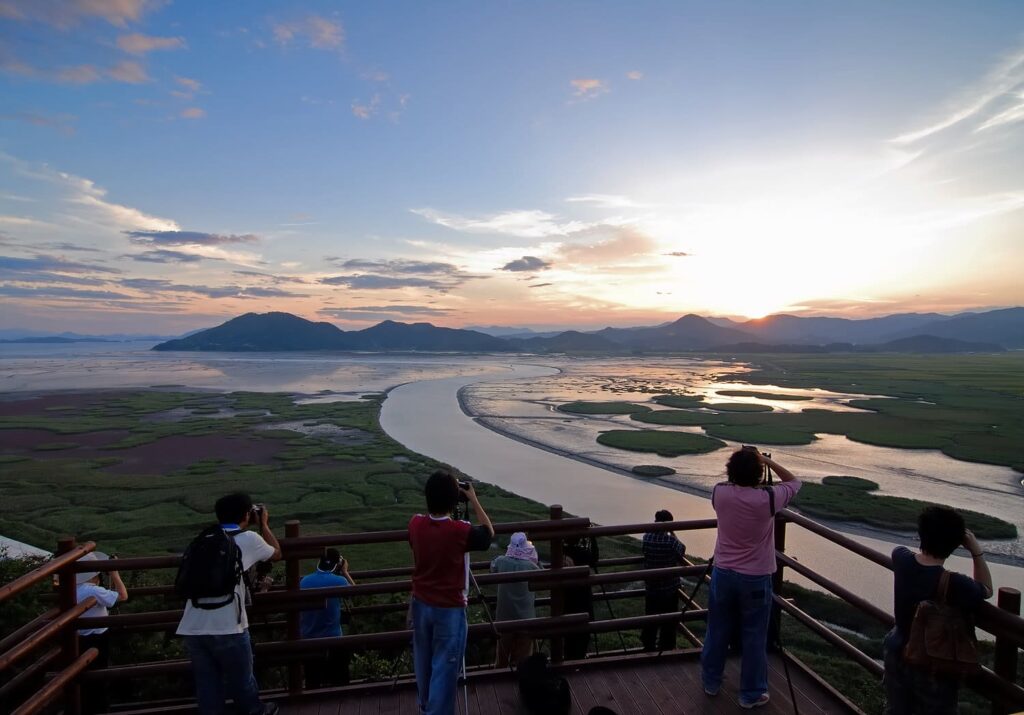
Another reason the place works well for foreign travelers is that it has a clear rhythm. You are not just standing at one viewpoint and leaving. The official pages frame the wetland as an ecological tourism site and point directly to the sunset over the S-shaped waterway as one of the signature experiences. That makes the visit easy to understand even before you get there: walk through the reeds, keep going, and let the final view do the rest.
There is a practical side too. The wetland is open year-round, with seasonal hours listed by VISITKOREA as 08:00–17:00 from November to February, 08:00–18:00 in March-April and September-October, and 08:00–19:00 from May to August. The observatory area is listed as open from 08:00 to sunset, with some park facilities unavailable on Mondays and national holidays.

If you want, you can also connect this post naturally to Nami Island and Seoraksan National Park as contrasting Korea nature destinations. Suncheon is not about mountain adrenaline or postcard neatness. It is about open space, moving reeds, and the kind of silence that still feels alive. That is an interpretive comparison, not wording from the official tourism pages.
In the end, Suncheon Bay Wetland stays with people because it does not rush to prove itself. The boardwalk, the reeds, the mudflats, and the observatory all build toward one feeling: that this part of Korea is best understood slowly. And for a travel blog, that makes it especially useful—not just as a place to see, but as a place to experience at the right pace.