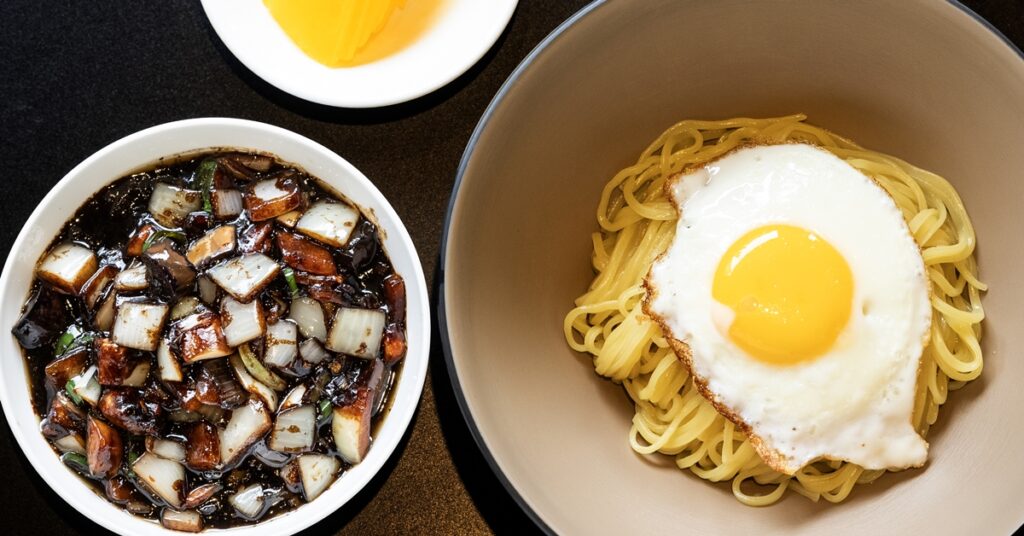

Some Korean foods impress people right away with heat, color, or strong flavor. Jajangmyeon often works differently. For many first-time visitors, the black sauce is the first surprise. It looks heavier than expected, maybe even a little mysterious, but the actual feeling of the dish is much softer and more familiar than the appearance suggests.
That contrast is part of why jajangmyeon stays memorable. It is rich, but not in a showy way. Sweet, savory, and a little earthy, with a smooth sauce that clings to the noodles and makes the whole bowl feel comforting almost before you finish the first few bites. It is not the kind of Korean food people usually imagine first when they think of spice or barbecue. It is more everyday than that, and that is exactly where its charm begins.
In Korea, jajangmyeon is not just “a noodle dish.” It belongs to ordinary time. It is the kind of meal people order when they want something fast, filling, and familiar. It appears in solo meals, lazy weekends, quick lunches, and those very specific moments when nobody wants to cook but everybody still wants something warm and satisfying. That everyday role matters because it makes the dish feel emotionally close, not just culturally famous.

Another reason foreigners tend to remember it is that jajangmyeon tells you something about Korean-Chinese food culture. It is not presented in Korea as a rare specialty or an intimidating traditional ritual meal. It is casual. Practical. Deeply woven into normal life. That makes it a very good food to introduce on a blog like this, because it shows how Korean food culture is not only built on famous national dishes, but also on the meals people grow up eating without needing a special occasion.
There is also a strong visual memory attached to it. The bowl usually comes with raw onion, pickled radish, and sometimes a bit of extra sauce on the side. That simple setup is instantly recognizable in Korea. It does not look luxurious, and it is not trying to. Jajangmyeon feels dependable instead. It is one of those meals people trust to do its job: fill you up, settle your mood, and move the day along.
That is why the food connects so naturally with other Korea Day One posts like Korean convenience store food or Kimchi Jjigae. Those foods also work because they are tied to routine rather than spectacle. Jajangmyeon fits that same world, but with a different texture. It is smoother, softer, and a little more playful in flavor. And unlike a dish that builds itself on heat, it wins by being immediately easy to return to.

A lot of travelers also end up understanding Korea’s delivery culture through jajangmyeon. Even if they first meet it in a restaurant, the dish carries the feeling of a food that belongs to speed, convenience, and neighborhood rhythm. It is easy to picture someone eating it alone at home, sharing it with family on a busy day, or ordering it because nothing else sounds quite as right. That kind of food always says something real about a country.
And maybe that is the best way to understand jajangmyeon. It is not trying to be beautiful in a delicate way. It is not trying to shock you with bold spice. It is simply one of those foods that Korea made deeply its own by making it part of normal life. Once you understand that, the bowl stops looking unusual and starts feeling exactly like what it is: one of the most ordinary comfort foods in Korea, in the best possible sense.